The Ledger: Pay Jesper Wallstedt now, before a full season sets the price
Eight starts in nine at .921 on a $2.2 million bridge, a $6.8 million goalie on LTIR, and Quinn Hughes first in line for next summer's room.
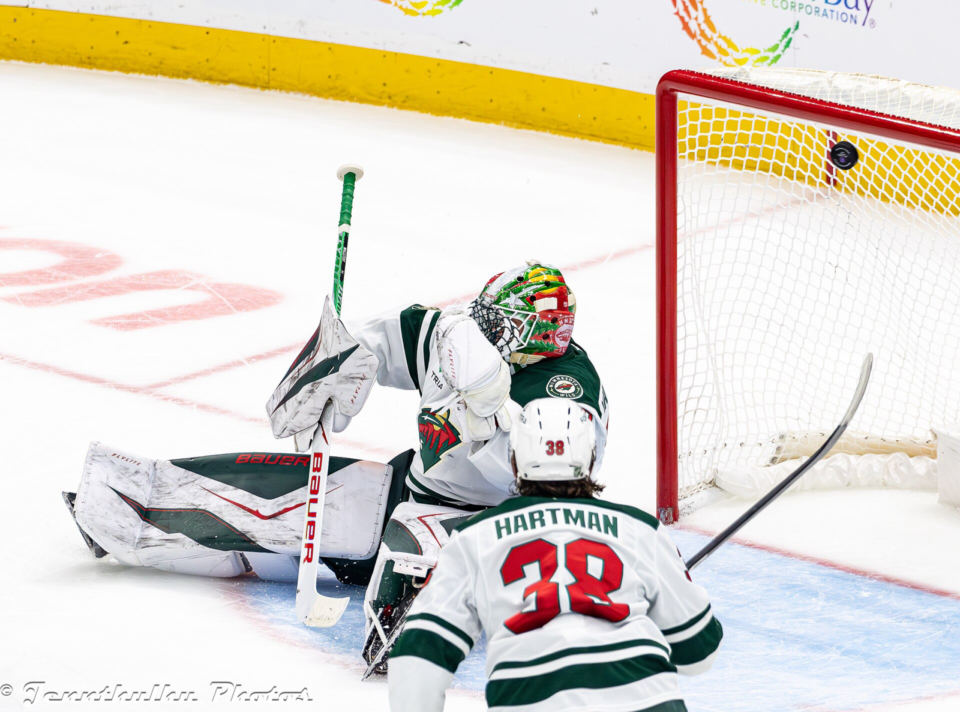
The number: 8. That's how many of Minnesota's nine games Jesper Wallstedt has started, by our count, and he's 6-1-1 with a .921 save percentage and a 1.99 goals-against average doing it. He costs $2.2 million.
The goalie the Wild actually paid, Filip Gustavsson, is on long-term injured reserve at $6.8 million with a no-move clause. Bill Guerin should call Wallstedt's agent this week, because every start at this level raises the price of the next contract.
The Wild didn't plan it this way. Gustavsson signed his five-year, $34 million extension on Oct. 4, 2025, as the starter with a sixth-place Vezina finish behind him, while Wallstedt sat on a two-year bridge.
Then Gustavsson slumped, Wallstedt took the net for the playoffs and won five of ten starts, and nobody has taken it back. Gustavsson had hip surgery in May and went on LTIR on Oct. 9 with no timeline.
So Minnesota is paying starter money to the guy in the press box and bridge money to the guy carrying a 6-2-1 team, which works until July.
Cap sheet: Minnesota Wild
-
Space today: $487,395, with a $3.83 million LTIR pool, per PuckPedia as of Monday. Projected about $3.0 million over the ceiling once the LTIR bodies return, so Brock Faber's and Gustavsson's activations each cost somebody a roster spot.
-
Contracts: 44 of 50. Retained-salary slots: all three open.
-
Next summer: $68.5 million committed against a $113.5 million cap, about $45 million of room with 12 of 23 roster spots filled. Quinn Hughes is unrestricted at $7.85 million, Wallstedt is a restricted free agent with arbitration rights, and Calvin Pickard, the backup, is unrestricted.
That $45 million sounds like a lot until you remember who's first in line. I priced Hughes at $19.5 million last month, and nothing since has lowered it. Take that out and the Wild have roughly $25 million for ten bodies, one of them a starting goalie.
Sign him now / Wait
Sign him now. Wallstedt is 24 next summer with 33 starts last season, eight this fall and a playoff run as the No. 1 on his record. That's a thin file, and a thin file is a discount.
A deal signed this fall is priced on what he's done, while a deal signed next July is priced on a full season of it. Minnesota buys his prime at today's number and never sees an arbitration hearing.
Wait. Eight starts is eight starts. He's faced 25 shots a game, and Sunday's win over Columbus was a 14-save night behind a team killing 89.3 percent of its penalties per NHL data. If the .921 is a hot month on a good defensive team, the Wild pay for a month. Waiting also keeps the Gustavsson decision open.
My call: sign him now. The downside of waiting is a bigger number; the downside of signing is a good goalie on a fair deal. Last season's .915 in 33 starts is the baseline, not the ceiling, and the comparables below say the baseline already clears $6.5 million.
The comparables
-
Dustin Wolf, Calgary: seven years at $7.5 million, signed September 2025 at 24, starting this season.
-
Lukas Dostal, Anaheim: five years at $6.5 million, signed July 2025 at 25, after one season as the clear starter.
-
Spencer Knight, Chicago: three years at $5.83 million, signed September 2025 at 24, a short bet on a smaller record.
-
Jake Oettinger, Dallas: eight years at $8.25 million, signed October 2024 at 25, the ceiling for a young starter who's already proven it.
The price
This is my projection, not a report. Signed now, with last season's 33 starts and one playoff run on the file: six years at $6.75 million, about 6 percent of next year's cap. Signed next July after 50-plus starts at .915 or better: seven or eight years at $8.5 million, in Oettinger territory.
The gap is roughly $1.75 million a year for the life of the deal, which buys a second-line winger in the 2027 market.
An extension signed now starts in 2027-28, so his $2.2 million hit stays on this year's sheet and the LTIR math doesn't change.
The Gustavsson problem
The numbers say the $6.8 million goalie is the trade chip, not the $2.2 million one, but the structure says it's harder than that.
Gustavsson's deal is front-loaded, $8.0 million in real salary this season and $8.5 million next, with a full no-move clause through 2027-28 before it drops to a 15-team no-trade list. A team taking him on this winter pays the most expensive years for a goalie who hasn't played since May.
The realistic window opens in the summer of 2028, when the salary falls to $7.2 million and the protection loosens. That's two more seasons of carrying both, unless Gustavsson decides he'd rather start somewhere else and waives. Guerin said in May that he liked having two No. 1 options who work well together. The cap sheet won't, once Hughes signs.
What I'd watch
Gustavsson's return date. The day he's activated, the Wild are back against the cap and someone goes out.
Settle Wallstedt's number before that and Guerin is negotiating against a $2.2 million contract and a 33-start record; settle it after and he's negotiating with a goalie who held the net in front of a healthy $6.8 million alternative. That's a different conversation, and a more expensive one.