The Panthers power play is 1-for-28, and the fix is structural
Reinhart and Brady Tkachuk carry about $16.8 million in cap hits and zero points so far, and the deployment, not the talent, is why.
The Panthers don't have a talent problem on the power play. They have a structure problem, and right now it's costing them more than any number on the cap sheet.
The number: 1-for-28. That's Florida's power play through five games, 3.6 percent, last in the league by our count. Buffalo and Montreal are next at 5.9. Florida has drawn 28 chances, about five and a half a game, and turned exactly one of them into a goal, in the loss in San Jose.
It's a small sample, and I'll grant that. Five games is still long enough to see a pattern, and this pattern isn't bad luck.
Where the minutes go
Here's what the usage says, by our count from the NHL's game data:
-
Matthew Tkachuk: 36.7 power-play minutes, 4 points overall
-
Sam Reinhart: 34.3 power-play minutes, 0 points
-
Seth Jones: 33.3 power-play minutes, 1 point
-
Brady Tkachuk: 29.6 power-play minutes, 0 points
-
Sam Bennett: 26.4 power-play minutes, 3 points
Those five have carried the man advantage. Two of them haven't touched the score sheet at all, at any strength.
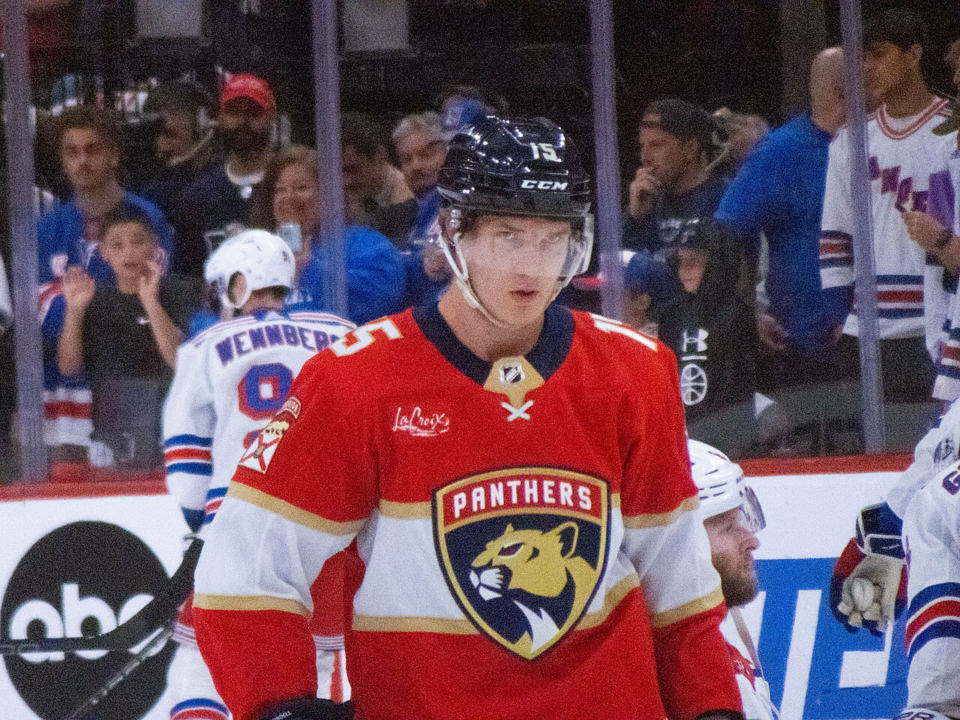
Reinhart is the one to sit with. He's averaging 21.6 minutes a night and 6.9 on the power play. No forward in the league has averaged more ice time this season without a point. He has 12 shots, so he isn't hiding; the puck just isn't finding him in the spots it did when Barkov was feeding the bumper.
The structure, not the shooters
The plan coming out of camp had Brady Tkachuk at the net front, Reinhart in the bumper, Barkov and Matthew Tkachuk on the flanks and Jones at the top. Then Barkov went down in Game 2 with another leg injury, Marchand is out too, and the whole thing lost its connector.
You can see it in the faceoff circle, where every power play starts. Reinhart has moved to center and won 13 of 33 draws, 39.4 percent, while Bennett is at 42.4.
Lose the draw on a power play and you spend 20 seconds skating back for a regroup instead of setting up. The best clip on the team belongs to Brady Tkachuk, 17 of 27, and he's the guy you want parked on the goalie's toes, not in the circle.
Even the opener, a 1-0 overtime win in Carolina, showed it: the unit had trouble just getting set, with three shots on the advantage.
What it costs
Reinhart carries an $8.625 million cap hit through 2031-32. Brady Tkachuk is at about $8.2 million through 2027-28. That's roughly $16.8 million of cap space with zero points between them through five games. That's not a verdict on either contract.
Reinhart's deal was fair the day he signed it and still is. It's a verdict on the deployment, because the team is paying for finishers and using them as puck carriers.
Maurice has already shuffled the even-strength lines, with Bennett centering both Tkachuks. The power play needs the same willingness to move a piece.
My adjustment: Brady at the net, Matthew running the half-wall, Reinhart on his off-side flank where he can shoot, and Lundell in the bumper. Lundell is the only healthy center over 50 percent on draws, at 51.4, which gets the unit the puck to start.
What I'd watch
Buffalo on Monday is the right test. The Sabres' penalty kill is at 62.5 percent, third-worst in the league, and Ukko-Pekka Luukkonen has stopped .782 of the shots he's seen in three starts. If Florida can't score on that, it's not a slump anymore. It's the system, and the fix has to come from the bench.