The NHL's scoring surge is a goalie story, not a camp story
Goals are up to 6.25 a game, but the rusty preseason scored less, the power play isn't driving it and save percentage sits at .890.
The scoring is real. The explanation everybody reaches for isn't. The popular theory blames the shortened training camp, but the preseason was the rustiest hockey anyone played this fall, and it produced fewer goals than October has.
The number: 6.25. That's goals per game through the first 55 regular-season games, by our count from NHL data. Twenty-four of those 55 games finished with seven goals or more. Only six finished with three or fewer.
What the camp argument gets wrong
The new collective agreement turned camp into a sprint. Most teams played four exhibition games, and any player with more than 100 NHL games could dress for two at most. That's the compromise the league accepted in exchange for an 84-game schedule.
So the theory goes: nobody had time to install structure, and the defensive systems are still sitting in the equipment room. Don Waddell called the early play "a little more scrambly," and Steve Staios said it's been "a little bit sloppy to watch."
I don't doubt the eye test. I doubt the cause. The 65 preseason games in our archive averaged 5.52 goals.
That was the hockey with the least structure in it, with half-rosters and tryout lines, and it produced roughly three-quarters of a goal less per night than the regular season has.
Where the goals are coming from
Not the power play. Teams have scored 78 of the 344 goals with the man advantage, on 374 opportunities, a 20.9% conversion rate across the league by our count.
Nothing in that line suggests a special-teams explosion, and officials aren't manufacturing extra chances, either. Combined penalty minutes have dropped to 22.0 a game, from 27.5 in the preseason.
It isn't volume, either. Teams are averaging about 26.7 shots apiece, which is not exactly a shooting gallery for the goaltenders.
It's the finish. League save percentage sits at .890 through 55 games, by our count, and .900 at even strength. When a goalie stops 89 of 100, a 26-shot night turns into three goals against without anybody doing anything special.
The stars are cashing in
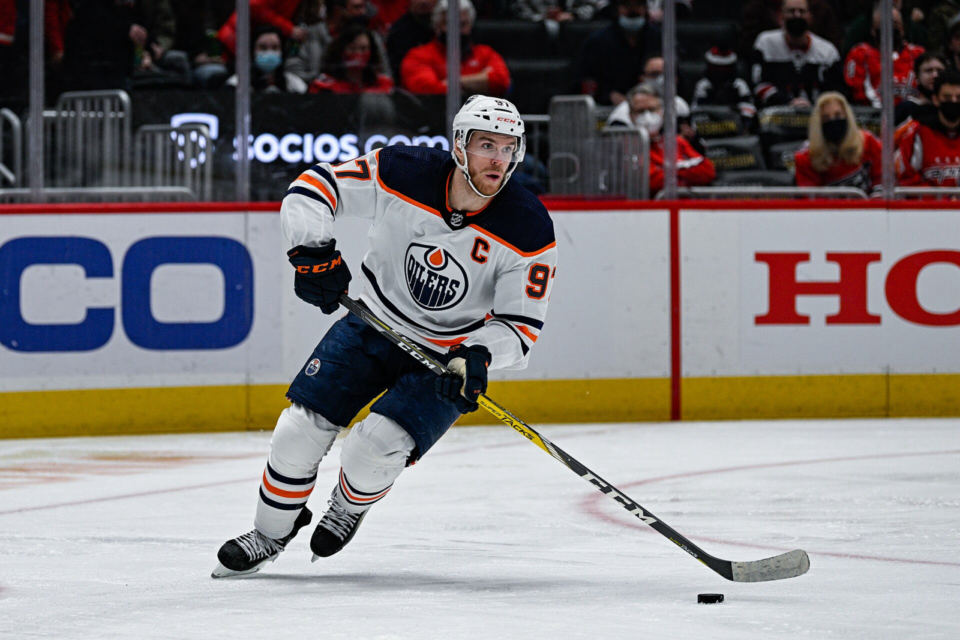
Some of this is just talent with open ice. Connor McDavid has 12 points in four games, nine of them assists, on 23.9 minutes a night per NHL data. Evan Bouchard has six goals in those same four games while playing 25.1 minutes. Jack Eichel has 10 points.
The Oilers and Canucks combined for 16 goals in one night, a 9-7 Edmonton win. That's a fun box score. It's also the kind of game a goalie coach replays on mute.
Why I'd bet on it settling down
Shooting percentage is the least stable number in the sport over a small sample, and three or four games per team is a very small sample. Goaltenders typically recover their timing more slowly than skaters, and under the new limits the veteran starters got very few exhibition repetitions.
The camp change did matter, just not the way people say. It didn't break the systems. It took away the goalies' warm-up.
The surge is good business in the short run, because a 9-7 game sells. But the general managers who invested in goaltending, the ones paying a starter real money, are the ones who'll look smart by Christmas.
What I'd watch: league save percentage on Nov. 1. My call is that it's back above .895 by then and the scoring average is under six goals a game. If it isn't, the shorter camp has a bigger story than rust, and I'll say so.